
Breaking the Silver Ceiling
We don’t know what she looked like. It was too early for photography, and she wasn’t of the class which celebrated itself with painted portraits. But picture a face hardened by labor – thousands of hours in cacophonous workshops, eardrums wracked by hammers and skin toasted by fire.
It’s a truism that 18th century commerce was male dominated, yet hundreds of women were registered as silversmiths in 17th and 18th century England. Like most, Hester Bateman was a widow who inherited her husband’s business. Like some, she was also an entrepreneur in her own right. Guild records show that women were commonly employed as laborers in silver shops, and while we don’t know what specific tasks they performed, it’s safe to say that women wielded the tools of the trade.
None were as successful, innovative, and ultimately as collectible as Hester. In 1761, at 52 years old, she assumed control of her deceased husband’s modest silver wire business. Hester had more ambitious plans. For the first decade of her leadership, the company primarily made pieces as a supplier for other London silversmiths. But in the 1770s, she shifted to a retail model, quickly establishing hers as one of the most prominent silver shops in England.
Hester’s business pioneered using thinly rolled sheet silver as the starting point for a piece, rather than painstakingly hand hammering every element directly from an ingot. Using less labor and less silver meant lower prices. For the first time, “everyday” sterling silver objects like coffee pots, teapots, and sugar bowls became attainable to middle class (or at least upper middle class) Londoners, rather than almost exclusively to the aristocracy.
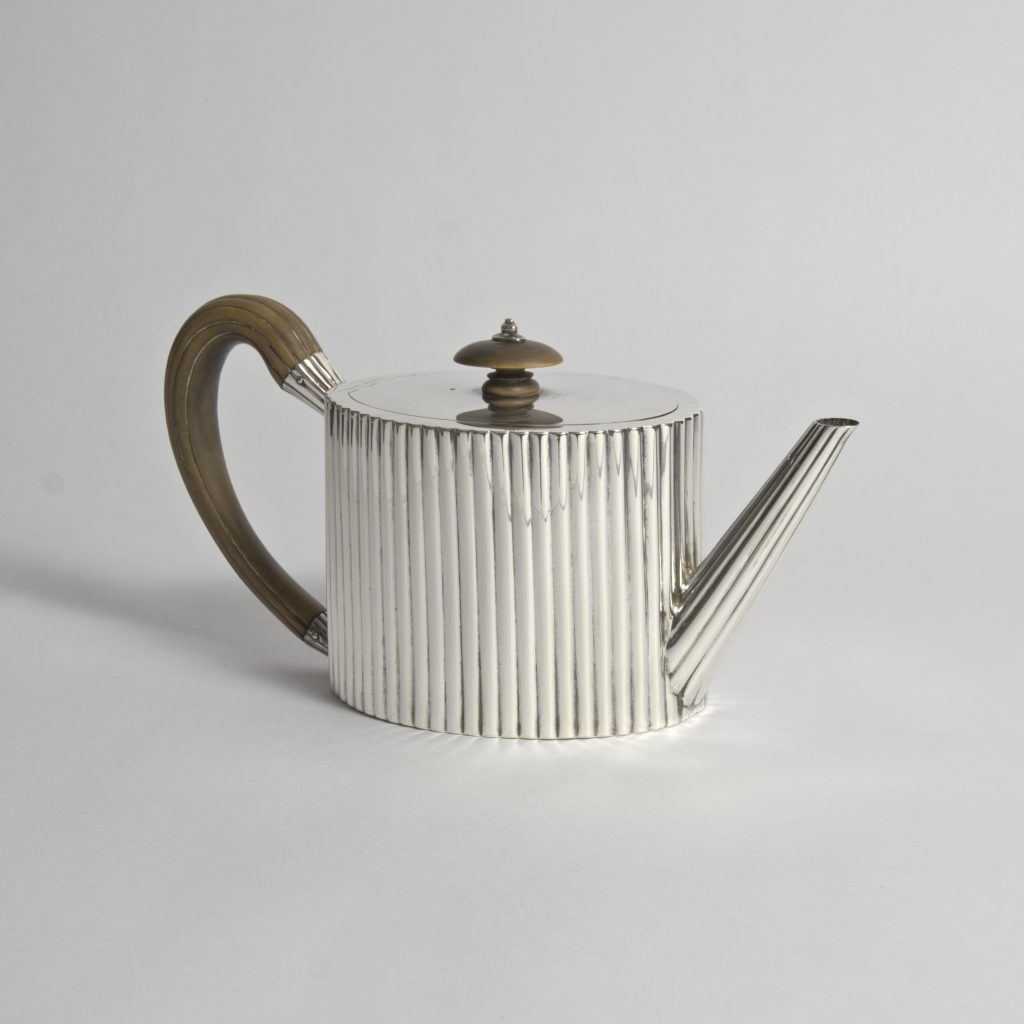
By 1784, the year this teapot was made, Hester Bateman’s name was synonymous with household silver. Her firm churned out an astonishing volume of wares. Even at 76 years old, she was going strong – she would only retire five years later, at age 81, turning the business over to her children.
The modern looking design of this piece is rare in Hester Bateman’s work. She’s better known for her trademark plain neoclassical style, with beadwork or gadrooning. This unusual ribbing is more often seen in subsequent decades, including in the work of Hester’s children.