
An Opera Singer’s Honorary Chiefdom
This historically significant portrait captures a remarkable moment in 19th-century First Nations diplomacy and intercultural exchange, vividly embodied in the figure of Edward Seguin. Painted by James Hamilton Shegogue in 1840, the work prominently features traditional dress of the Huron-Wendat Nation, emphasizing Indigenous diplomatic traditions and their engagement with transatlantic cultural figures. As a work of American art, it straddles the threshold between performance and politics, artifice and authenticity, spectacle and sincerity.
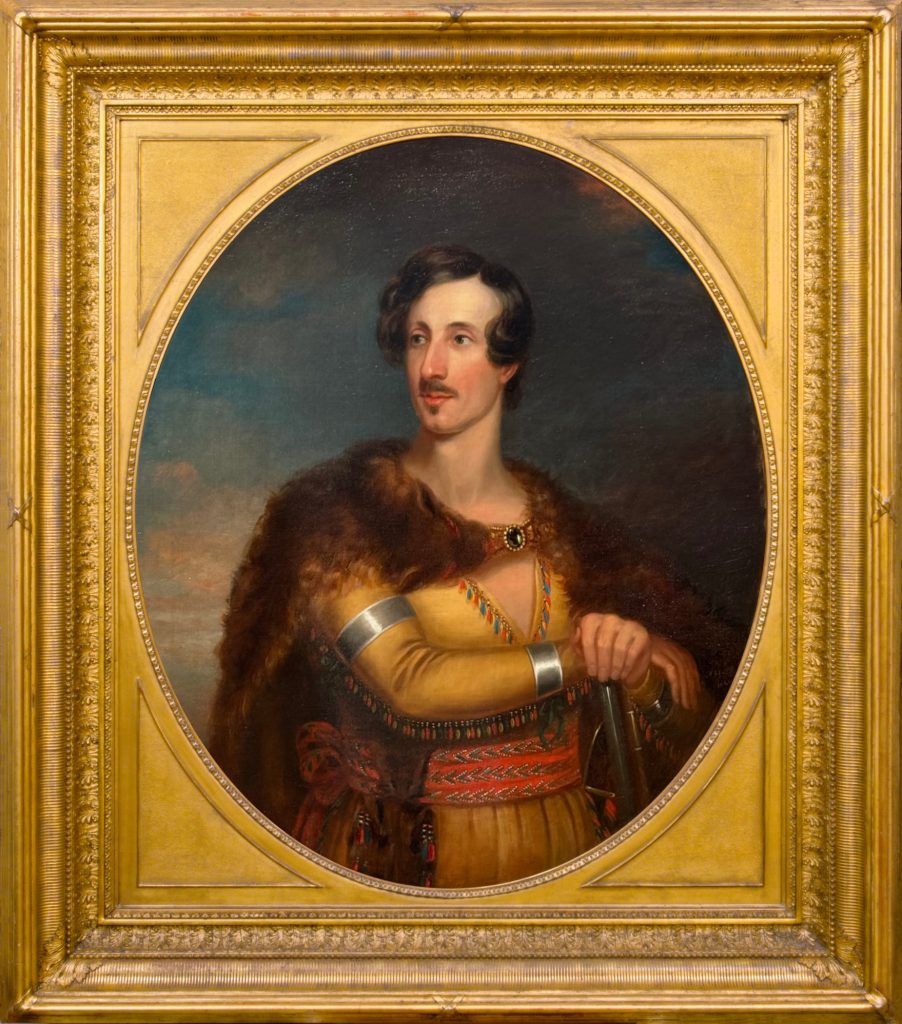
Oil on canvas, 39 x 33 inches (frame 51 x 45 inches)
Edward Seguin
Seguin, born Arthur Edward Sheldon Seguin in London in 1809, was an internationally acclaimed Anglo-American opera singer “whose equal never was heard before or since”[1]. Seguin performed at the coronations of both King William IV and Queen Victoria. The son of a French Naval officer and himself a member of a prominent theatrical family, Seguin’s career took him across Britain, the United States, and Canada. He emigrated to the United States in 1838, and formed the Seguin Troupe, which performed a repertoire of classical opera across North America. In the summer of 1840, he had become a fixture in Montreal’s cultural life, performing a celebrated season at the Theatre Royal. On August 19, 1840, he was formally received by the Huron-Wendat Nation at Jeune-Lorette and recognized with an honorary chiefdom—one of a few carefully selected non-indigenous figures to be so recognized.
Seguin was given the title “Wach-n-wachn,” meaning “The Great Diver,” a reference to a migratory aquatic bird known for its solitary nature and evocative song.[2] In the symbolic lexicon of Huron-Wendat society, such a creature represented eloquence, endurance, and communion with water—an essential force in Wendat cosmology. Honorary chiefdoms were not bestowed casually; they formed part of a long-standing diplomatic strategy, through which the Wendat nation sought to build alliances, convey respect, and assert cultural sovereignty through ceremonial recognition. Edmund Kean, the great tragic actor, had received a similar honor a decade earlier while touring Canada, as the only other known recipient representing the performing arts. His investiture was likewise celebrated by the press and commemorated in print.[3]
The August 1840 ceremony, held in the Hall of Council in the Huron Tribal village of Lorette near Quebec, was richly theatrical in its own right. A contemporary newspaper report describes chiefs in full regalia, spectators drawn from the colonial and military classes, and an atmosphere thick with gunpowder smoke, chanting, and oratory. At its heart was the symbolism of the communal cauldron: a massive iron pot filled with soup, around which the participants danced, feasted, and affirmed bonds of kinship. Seguin was presented with a diploma of adoption, first in the Wendat language, then rendered in French and English. The occasion not only affirmed his honorary status but situated him within a cross-cultural lineage of diplomacy, performance, and mutual recognition.[2]
History of the Portrait
James Hamilton Shegogue’s portrait of Edward Seguin, painted in New York City in the months following this event, is a striking visual record of that ceremony and its cultural resonance. Seguin appears in a deerhide hunting tunic with traditional pendant tassels dyed in alternating red, yellow and blue hair or bristles secured by tin metal ferrules, just as found on traditional hide moccasins. (The deerhide tunic or shirt may have been a summer alternative to the Wendat’s heavy blue wool greatcoat seen in other iconography). Further traditional features of dress include silver armbands above the wrist and elbow, and a ceinture fléchée or woven wool sash suspending a pipe case made of a whole mink pelt (including head and paws), decorated with colored bristle tassels matching those on the tunic. He is armed with a traditional hunting rifle and hunting knife, the hilt of which can be seen at his side. Shegogue, known for his refined handling of drapery and texture, lavished particular attention on the interplay of color and ornament. But beyond its technical finesse, the portrait communicates an essential stillness and clarity: Seguin does not play a role here; he inhabits a position.
Seguin’s wife Anne, during an interview with author George Seilhamer, lavished particular praise on the portrait, hung in their drawing room, and the experience it captured:
Mr. Seguin was made a chief of the tribe at Lorette, near Quebec, in 1840, in recognition of the services his father had rendered the Indians when a deputation visited London in 1821 [sic], and they wanted to make me a squaw, but I declined. We accepted their hospitalities, however, and gave them a breakfast at which we sung for them, Mr. Seguin singing God Save the Queen. I never saw any one so much astonished as the Hurons were when the powerful notes of Mr. Seguin’s bass voice came rolling out. They stared as they had never stared before. In consequence they gave him the name of H-gen-h-gen, the Great Diver. His voice went down so low, they said, that they thought it would never come up again.[1]
Indeed, the Seguins were no strangers to the press. The following passage was published in the Philadelphia Public Ledger, Feb. 25, 1841 (emphasis original):
Mr. Seguin, the most pleasing and therefore the most popular bass singer now on our stage, was thus criticized in a Philadelphia print for his recent performance in Mozart’s opera of the Magic Flute: “This gentleman sings well and has a fine voice, much spoiled, however, by taking snuff.”
On Wednesday we met Seguin in the promenade at Niblo’s. We caught him in the diabolical act of tickling his nose—an article or feature that he is largely gifted with—with a pinch of snuff; we mentioned this criticism to him.
“Oh,” said he, “that is a mere bagatelle. When I first appeared at Bath, in England, one of the papers there spoke of me thus: “Mr. Seguin has a splendid organ, rich, full and melodious, but he should cut his hair.“
In 1841 the portrait was exhibited at the National Academy of Design, where Shegogue was a frequent contributor and served as Secretary.[4] Recent conservation work has uncovered inscriptions beneath the canvas lining, including the phrase “his private property 15/5/42,” perhaps indicating the date May 15, 1842, which may suggest the painting was loaned for another public display shortly after.
The entry for JH Shegogue in Benezit’s Dictionary of Painters states “Le Metropolitan Museum de New-York conserve de lui le portrait de l’acteur Sequin.”[sic] At present the context around the portrait’s presence at the Metropolitan Museum of Art is unknown. Seguin and his wife Ann amassed a considerable art collection, including an important group of Benjamin West paintings which would be loaned to (from 1881) and eventually purchased by the Met in 1923. One plausible explanation is that the portrait was part of the loan group, but was sold to another party in 1923.[5] A reference available in the Frick Digital Archive places the painting with Mr. M.J. de Sherbinen, De Sherbinen Galleries, New York, in December 1932 and January 1933.[6]
Huron-Wendat Context
The 1825 engraving titled “Three Chiefs of the Huron Indians…” records a visit by Wendat leaders to London, during which they participated in ceremonial and diplomatic activities, obtaining an audience with King George IV at Windsor Castle to lobby for restoration of ancestral lands in Quebec.[7] Contemporary correspondence suggests that this embassy was orchestrated in part by English merchant Irving Brock, who was sympathetic to the Wendat cause and sought to leverage British political structures on their behalf.[8] During their London stay, the chiefs received hospitality from various figures, including the Seguin family, whose kindness was formally recognized fifteen years later. A contemporary report in the Montreal Courier reveals that the rank of chief was conferred upon Seguin in grateful remembrance of the hospitality shown by him and his father to the principal chiefs of the village during their London visit:
…the rank of chief had been conferred upon Mr. Seguin, in grateful remembrance of the kindness and hospitality to the principal chiefs of the village, when in London, in the year 1825, shewn to them by himself and father: he added, that in the names of those very chiefs (three of whom were present) he was proud, after fourteen years, to be enabled, in their own village, to give a small return to him, who, in a distant land, had proffered the hand of welcome and friendship.[9]
Comparable portraits by Shegogue are rare. His The Zouave Que Vive (Christie’s New York, 2017, now in the New Orleans Museum of Art) stands as his most visible success on the market to date, valued as much for its narrative depth as for its painterly quality. More broadly, the field of 19th-century American painting has seen increasing curatorial interest in works that depict, mediate, or contest the presence of Indigenous subjects. Paintings by George Forest Brush, Charles Bird King, and John Lee Douglas Mathies—though filtered through the romantic and ethnographic gaze—serve as historical benchmarks for assessing such portrayals. This work, by contrast, not only depicts a non-Indigenous man in Indigenous dress but records a moment when that dress was worn with sanctioned, ceremonial purpose.
As a document of First Nations diplomacy, theatrical history, and artistic exchange, Shegogue’s portrait of Edward Seguin stands alone. It invites research, reflection, and reinterpretation—and would offer any institution a compelling focal point for exhibitions or collections centered on cross-cultural histories of North America.
Provenance:
Exhibited, National Academy of Design, New York, 1841
With Edward and Ann Seguin until her death in 1888
Held by the Metropolitan Museum of Art, unknown dates
With De Sherbinen Galleries, New York, 1932
[1] George Oberkirsh Seilhamer, An Interviewer’s Album, New York: Alvin Perry & Co., 1881.
[2] The honorary title “Wach-n-wachn” and its meaning, as well as descriptions of the ceremony itself, were recorded in Hill’s New-Hampshire Patriot, September 16, 1840, which provides a detailed eyewitness account of the event. The orthography of this name, as well as the one recorded by Seguin’s wife (“H-gen-h-gen”) may reflect transcription errors. Jonathan Lainey,Conservateur at the Musée McCord Stewart, has suggested that the character “8” may have been incorrectly transcribed as “g”, and that both names may in fact be mis-transcriptions of the Wendat name 8enho8en, or Wenhowen.
[3] Edmund Kean’s honorary chiefdom by the Wendat is referenced in period theatrical histories and parallels Seguin’s similar reception. Kean’s depiction in Huron attire is preserved in an 1827 print by G. F. Storm, housed in the Victoria and Albert Museum: https://collections.vam.ac.uk/item/O158312/edmund-kean-esq-print-storm-g-f/.
[4] Exhibition Record of the National Academy of Design confirms this painting was shown by Shegogue in the 1841 annual exhibition.
[5] Helmut von Erffa and Allen Staley, The Paintings of Benjamin West, New Haven and London: Yale University Press, 1986.
[6] Available at https://library.frick.org/permalink/01NYA_INST/d73c5u/alma991004723339707141 .
[7] See “Three Chiefs of the Huron Indians…” (1825), an engraving published after the visit of Huron leaders to London, accessible at ResearchGate: https://www.researchgate.net/figure/Three-Chiefs-of-the-Huron-Indians-Residing-at-La-Jeune-Lorette-Near-Quebec-in-their_fig2_240102651 .
[8] The Life and Correspondence of Major-General Sir Isaac Brock, K.B.: interspersed with notices of the celebrated Indian chief, Tecumseh. Ed. Ferdinand Brock Tupper, London: Simpkin, Marshall, 1845.
[9] Montreal Courier, 26 Aug. 1840, “Installation of a Huron Chief”.