
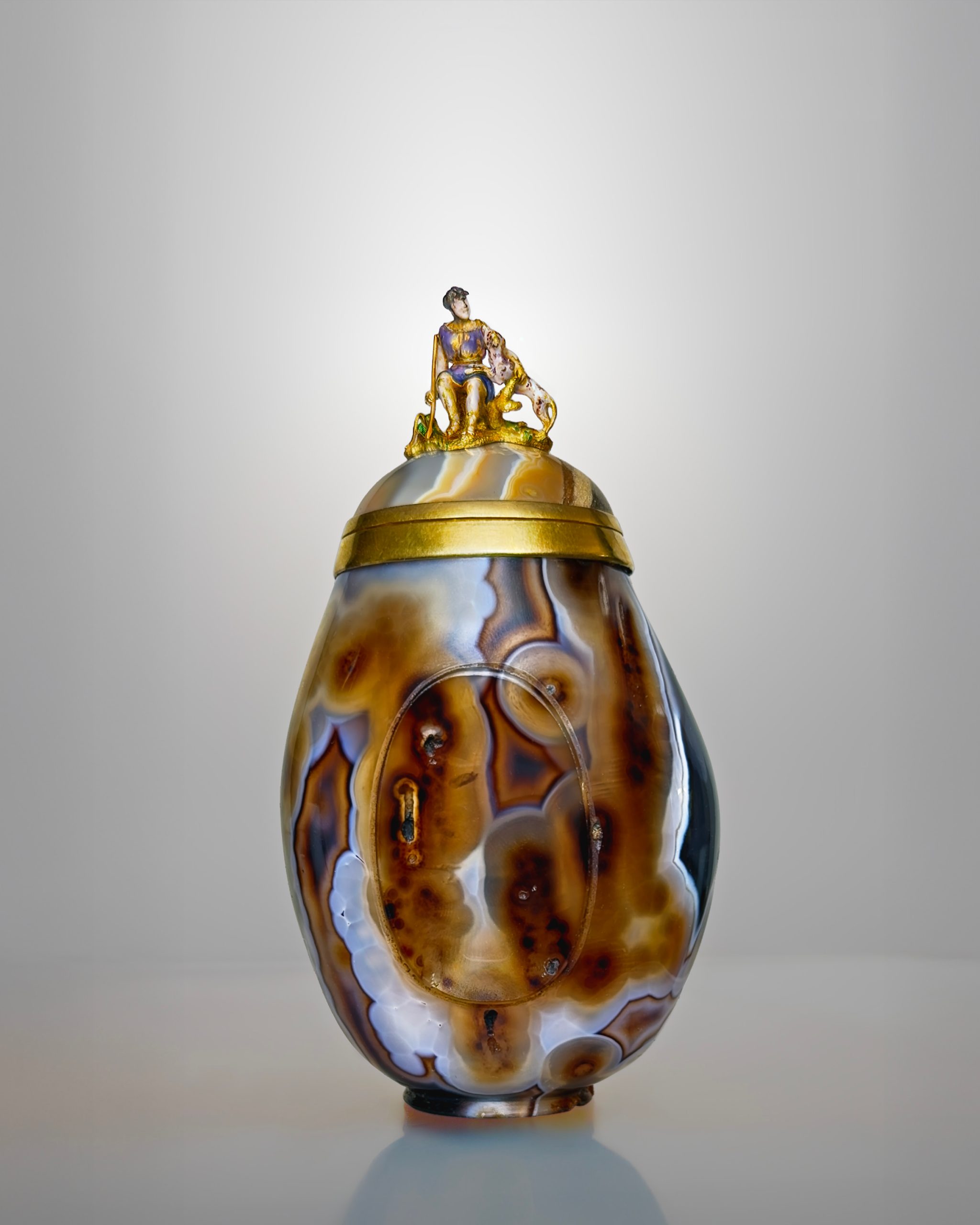
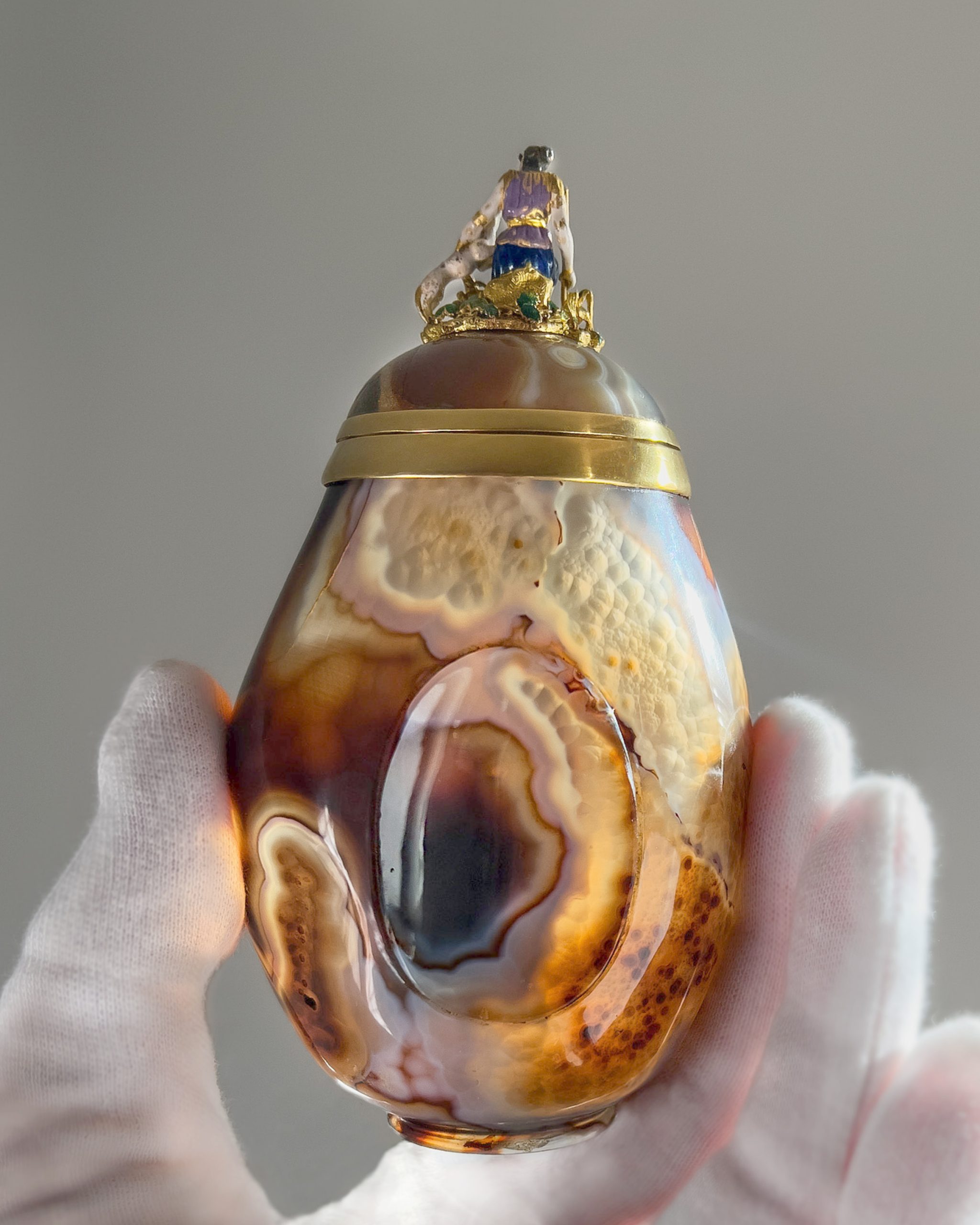
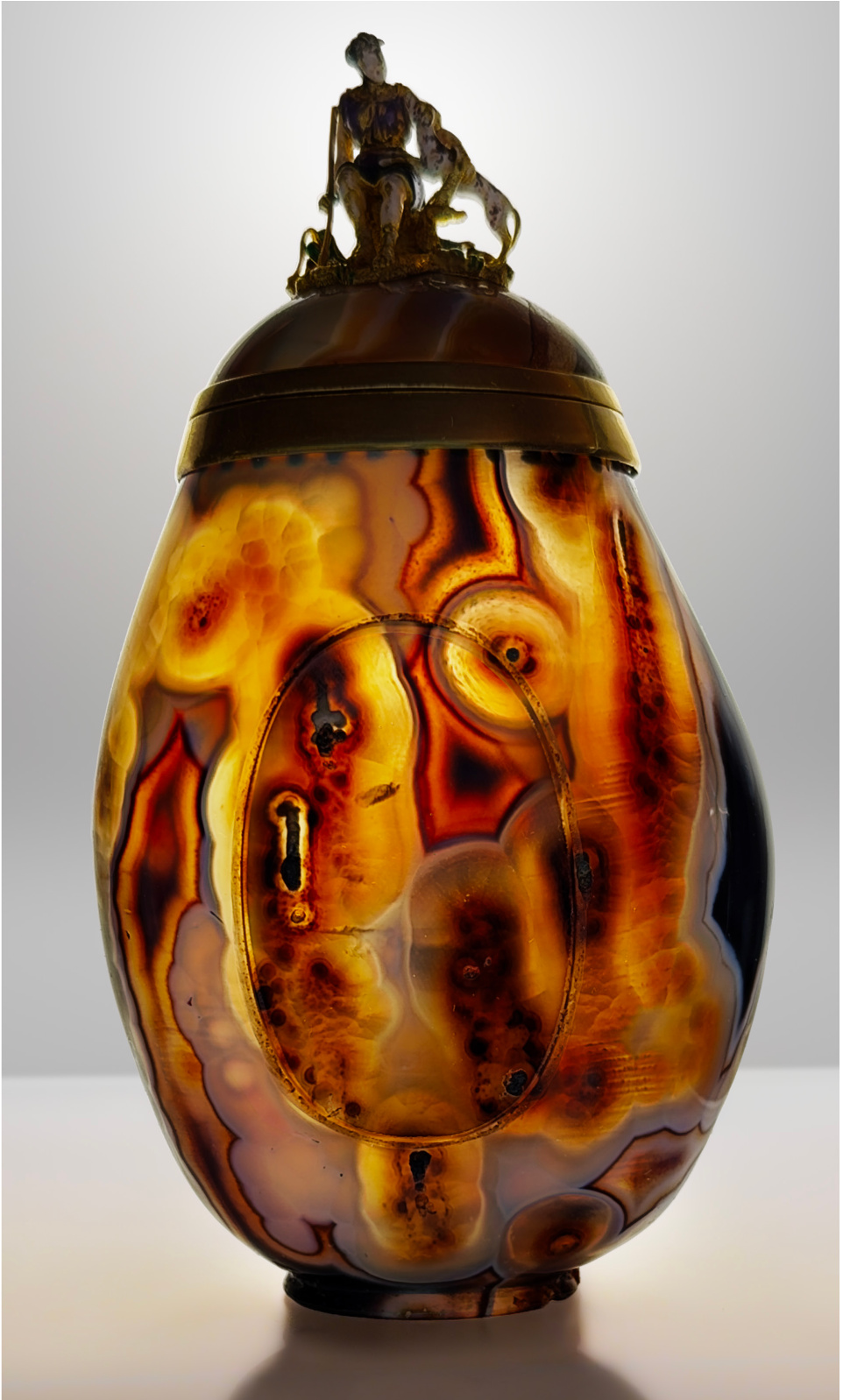
“Murrina Diana” flask, 1st-2nd century A.D.
Roman; the silver-gilt mounts Saxon c. 1680-1710
Height: 12cm; height of finial: 2.5cm
Murrhine vessels, highly prized luxury items in Ancient Rome, were sought after by Roman elites for their rarity and prestige. These objects, made from agates and chalcedony varieties, heated and honey caramel dyed, were extravagantly priced - Emperor Nero paid up to one million sesterces for a single piece. Introduced to Rome after Pompey the Great’s victories in the East (63 BC), Third Mithridatic War (73–63 BC) murrhine wares became a symbol of excess, criticized by figures like Seneca for their association with indulgence. Pliny ranked murrhine among the earth’s most valuable treasures, surpassing even gold and silver in desirability.
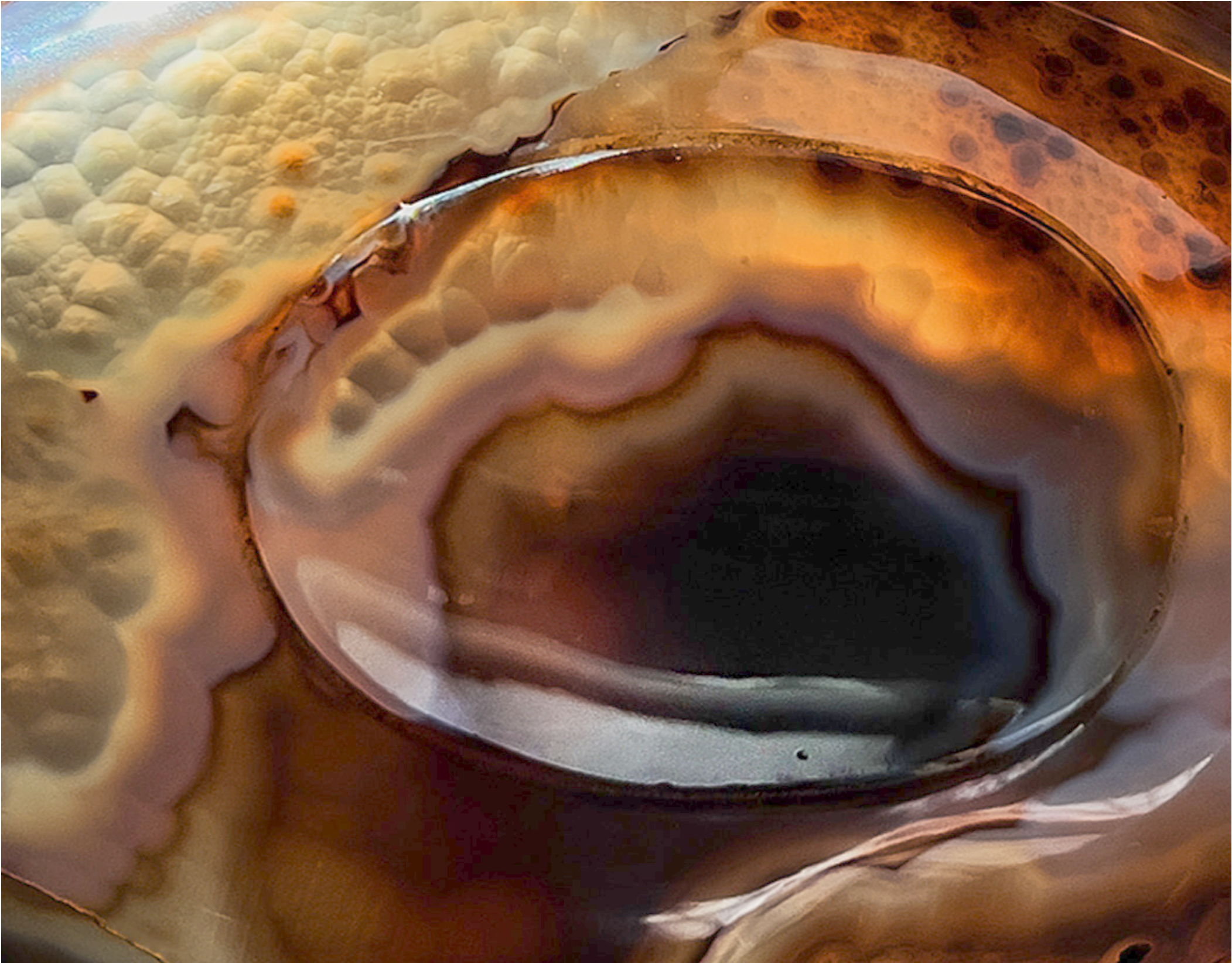
Carved in the 1st–2nd century A.D., this vessel preserves an unusual asymmetric pear-shaped form, hollowed with exceptional precision to a consistent 2–3 mm. Its sharply defined oval medallions and subtle channels testify to the highest level of Roman glyptic craftsmanship. Very few hardstone vessels of this scale and technical ambition survive.
The 17-18th c. cover is surmounted by a miniature figure of Diana and her hound in gold, silver-gilt, diamonds, and polychrome enamel—work closely aligned with Saxon goldsmiths active at the court of Augustus the Strong and indebted to the celebrated ateliers of Köhler and Dinglinger.
Only a small number of ancient murrhine vessels remain today, primarily in the Louvre, the Kunsthistorisches Museum, the Pitti Palace, and St Mark’s Basilica in Venice. The closest parallel is an aiguière in the Louvre (MR 115), acquired by Louis XIV, whose carved ovules correspond closely with those of the present flask.
Special thanks to Hans-Peter Bühler, “Antike Gefäße aus Edelsteinen”, 1973, and Dario Del Bufalo “Murrina vasa. A luxury of Imperial Rome”, 2016, for their invaluable scholarship on murrhine.
Murrhine vessels, highly prized luxury items in Ancient Rome, were sought after by Roman elites for their rarity and prestige. These objects, made from agates and chalcedony varieties, heated and honey caramel dyed, were extravagantly priced – Emperor Nero paid up to one million sesterces for a single piece. Introduced to Rome after Pompey the Great’s victories in the East (63 BC), Third Mithridatic War (73–63 BC) murrhine wares became a symbol of excess, criticized by figures like Seneca for their association with indulgence. Pliny ranked murrhine among the earth’s most valuable treasures, surpassing even gold and silver in desirability.
Carved in the 1st–2nd century A.D., this vessel preserves an unusual asymmetric pear-shaped form, hollowed with exceptional precision to a consistent 2–3 mm. Its sharply defined oval medallions and subtle channels testify to the highest level of Roman glyptic craftsmanship. Very few hardstone vessels of this scale and technical ambition survive.
The 17-18th c. cover is surmounted by a miniature figure of Diana and her hound in gold, silver-gilt, diamonds, and polychrome enamel—work closely aligned with Saxon goldsmiths active at the court of Augustus the Strong and indebted to the celebrated ateliers of Köhler and Dinglinger.
Only a small number of ancient murrhine vessels remain today, primarily in the Louvre, the Kunsthistorisches Museum, the Pitti Palace, and St Mark’s Basilica in Venice. The closest parallel is an aiguière in the Louvre (MR 115), acquired by Louis XIV, whose carved ovules correspond closely with those of the present flask.
Special thanks to Hans-Peter Bühler, “Antike Gefäße aus Edelsteinen”, 1973, and Dario Del Bufalo “Murrina vasa. A luxury of Imperial Rome”, 2016, for their invaluable scholarship on murrhine.
-
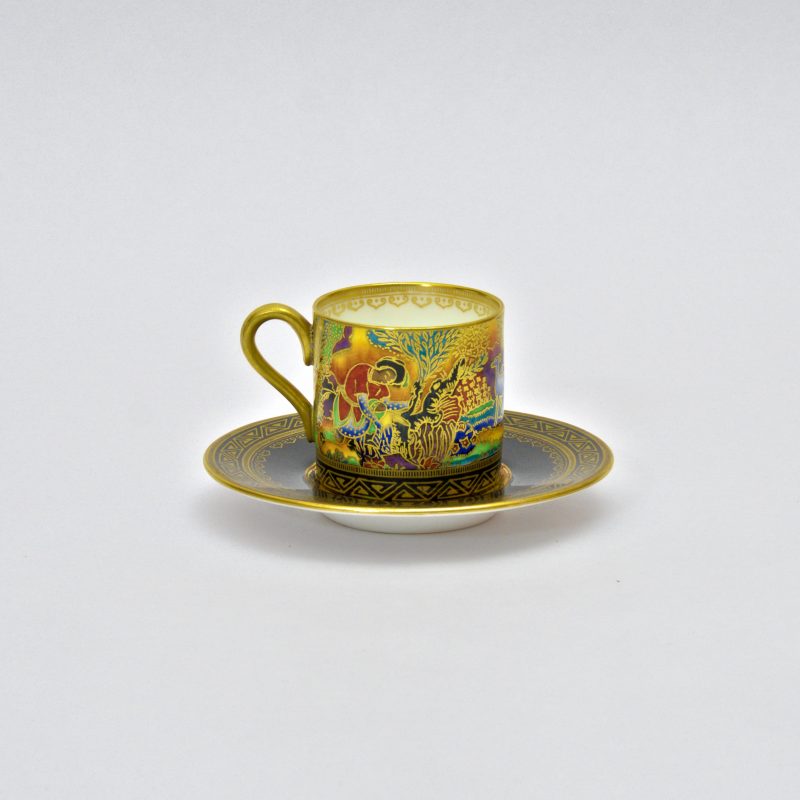 “Fairyland Lustre” Coffee Cup and Saucer, c. 1920
Discover the Object →
“Fairyland Lustre” Coffee Cup and Saucer, c. 1920
Discover the Object →
-
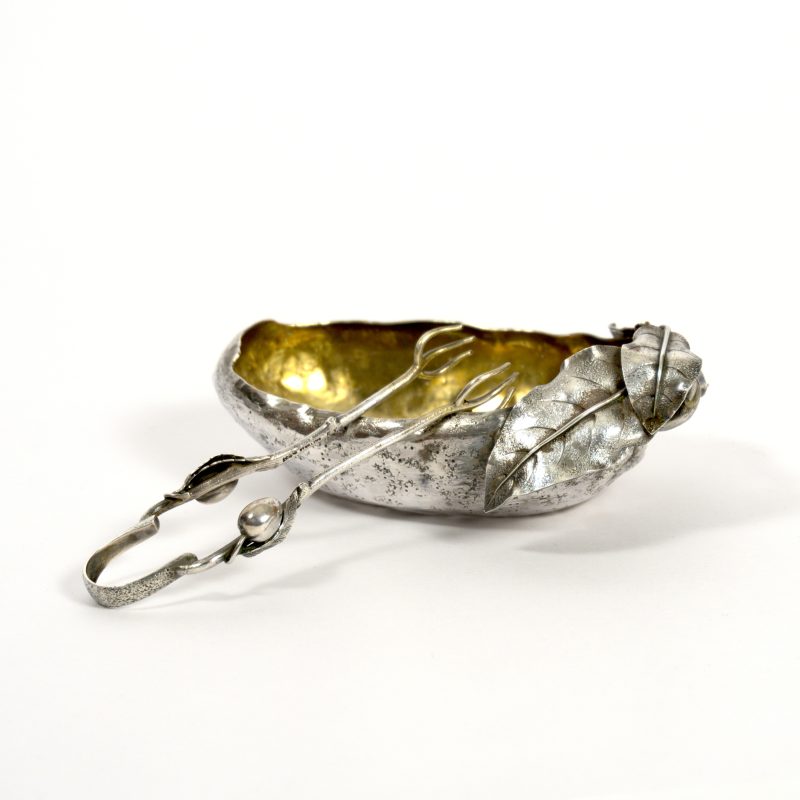 Silver Olive Dish and Tongs, 1884
Discover the Object →
Silver Olive Dish and Tongs, 1884
Discover the Object →
-
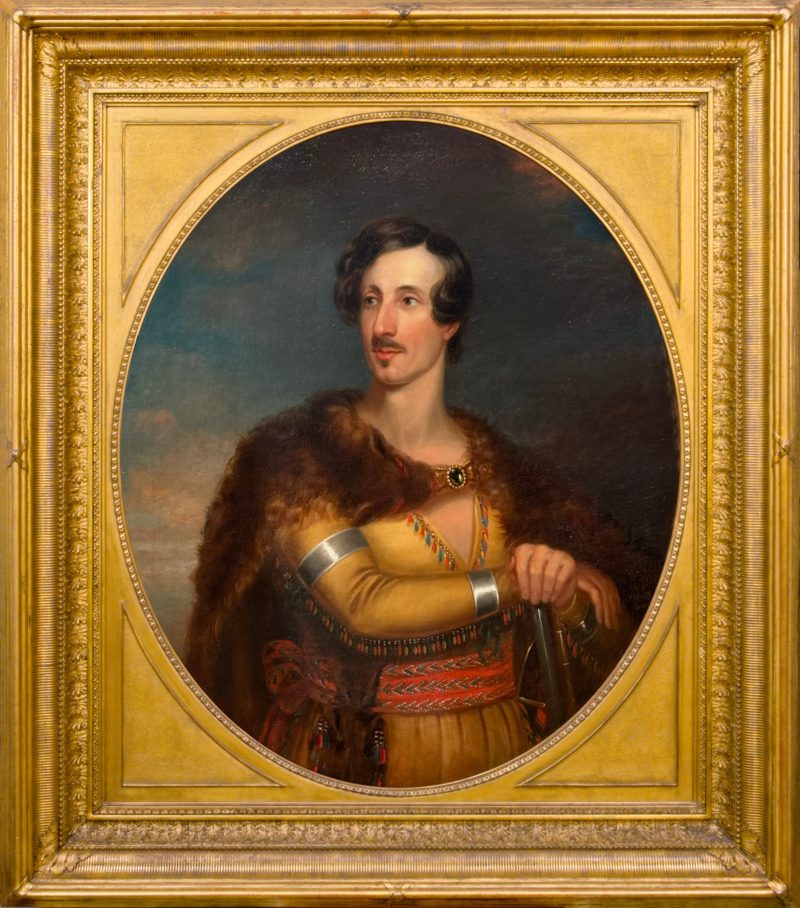 Portrait of Edward Seguin, 1840
Discover the Object →
Portrait of Edward Seguin, 1840
Discover the Object →
Reviews
There are no reviews yet.