
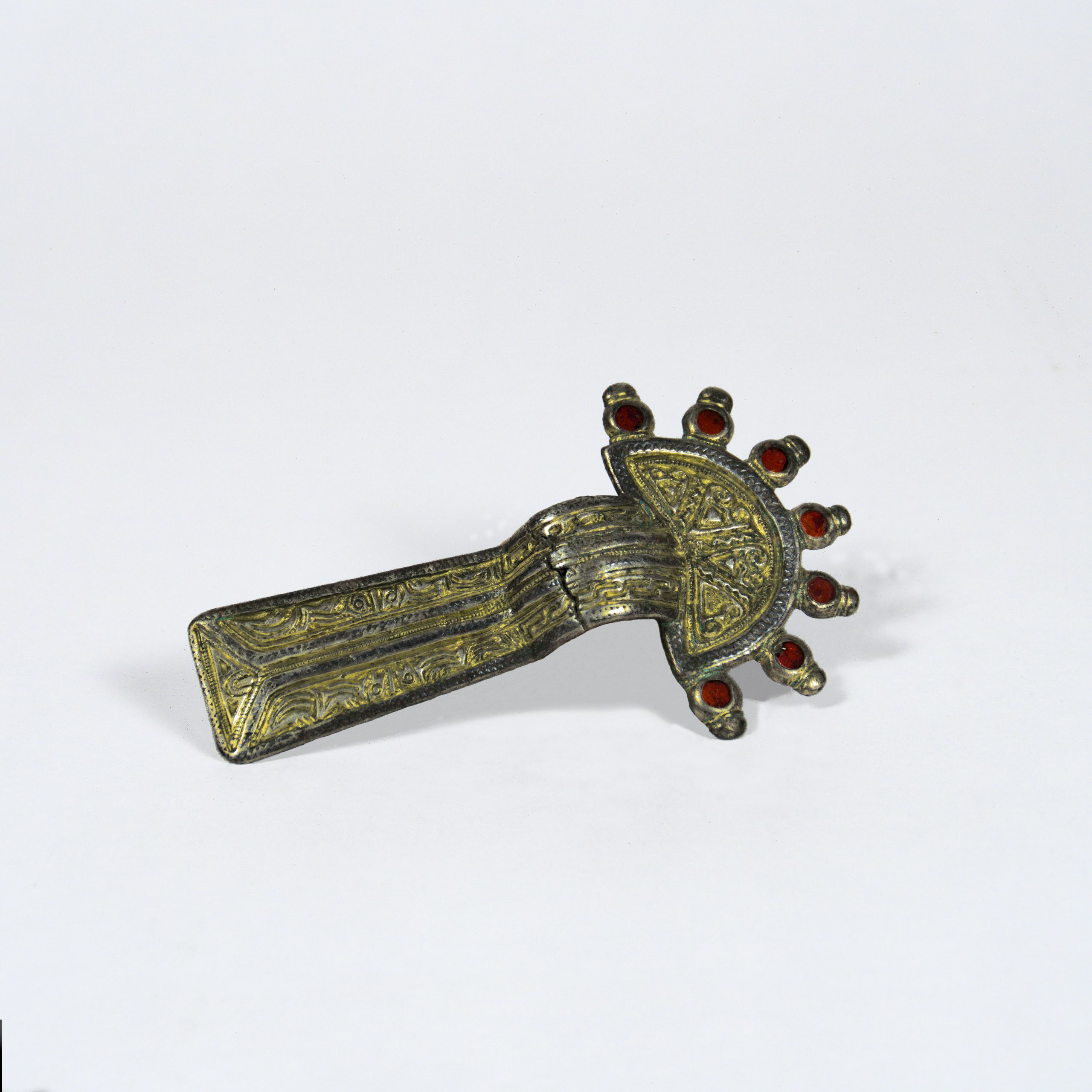
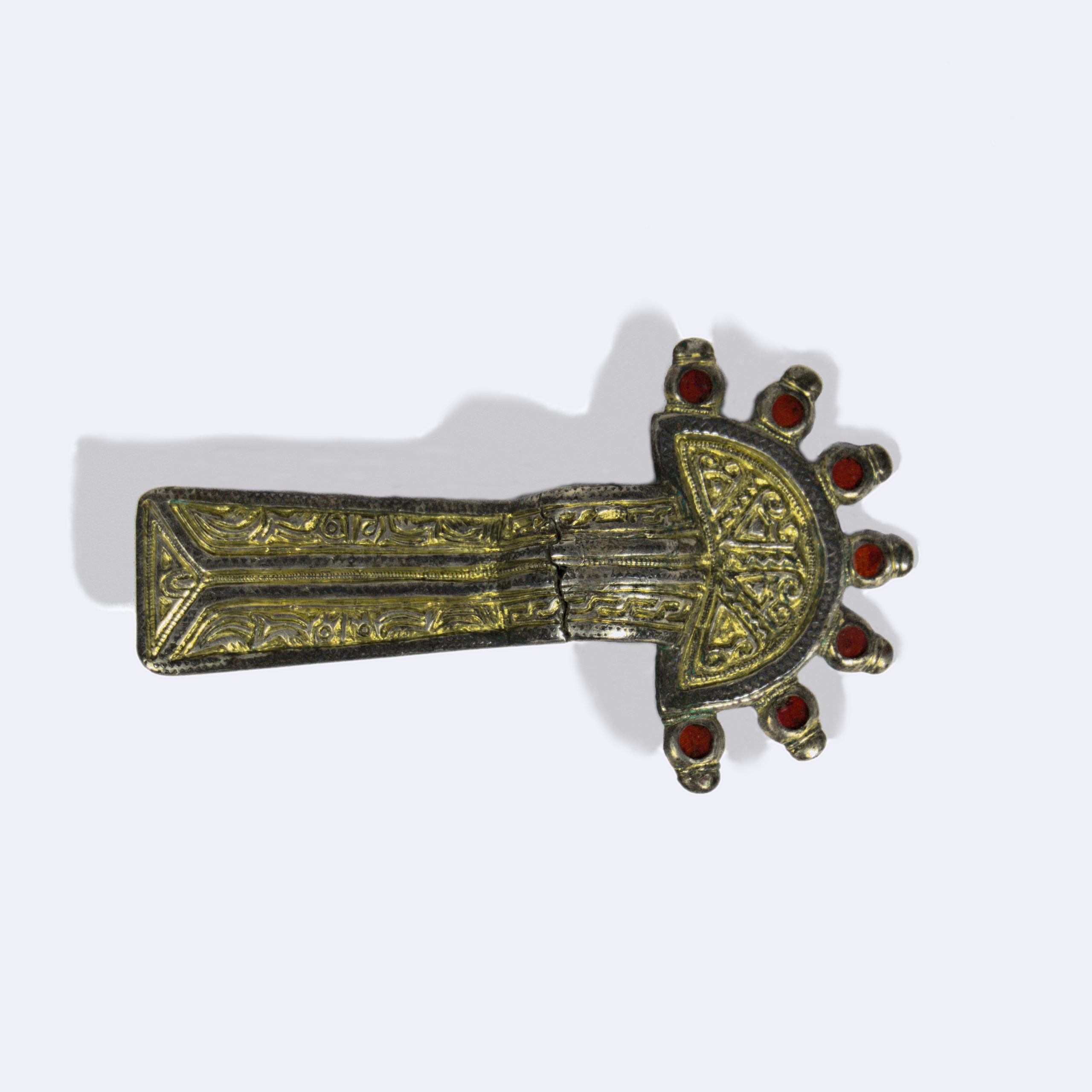
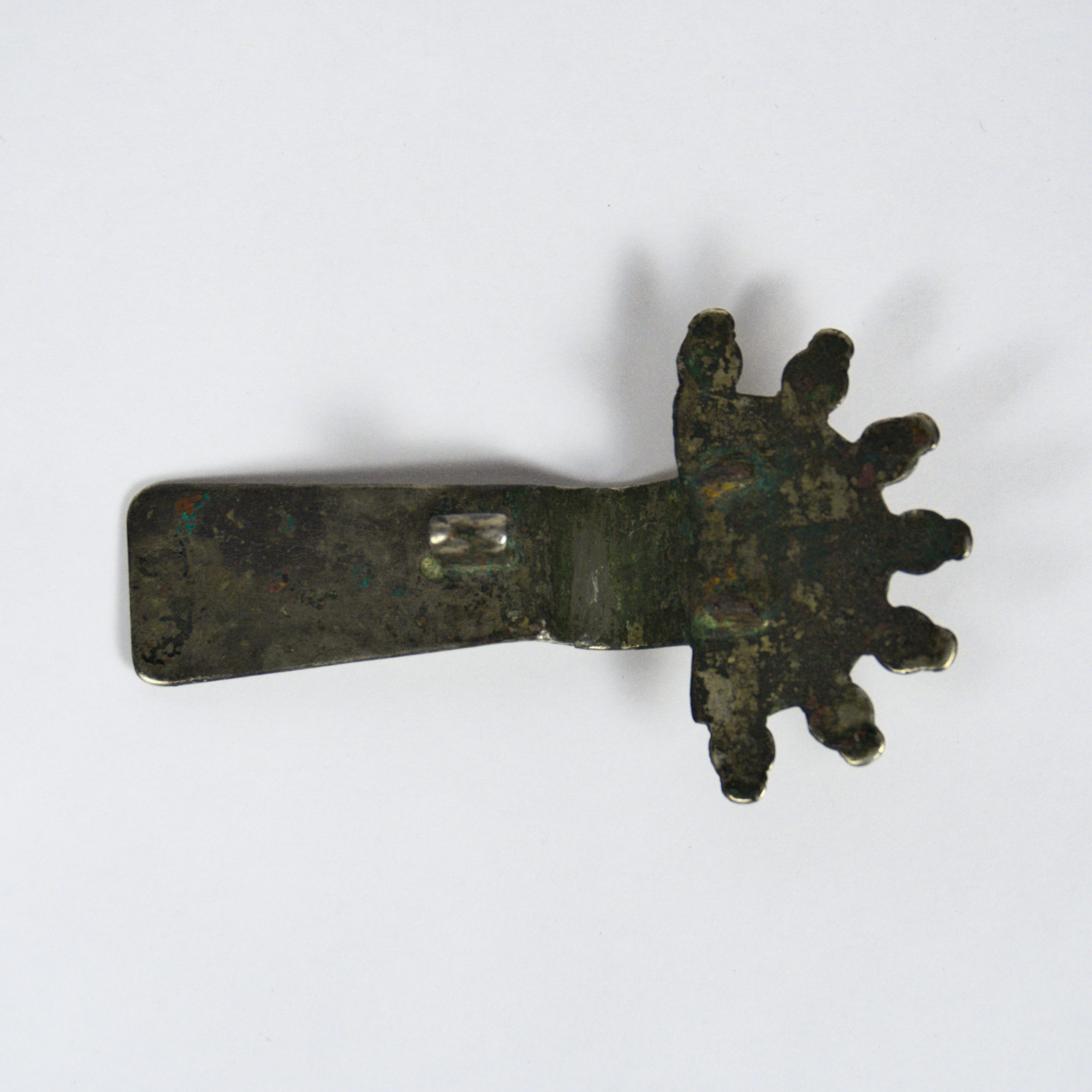
The Aussant Fibula, c. 530-570
France or Germany (likely recovered in Brittany)
Silver and silver-gilt, set with garnets
Length: 4.8 in.
A masterwork of Merovingian goldsmithing that survives not only with exceptional physical integrity, but with an unbroken provenance stretching back to the mid-19th century.
This radiate-headed fibula is a statement of elite status, crafted from silver-gilt and inlaid with garnets. It dates to the second or third quarter of the 6th century, a volatile era in Northern Gaul when the Frankish aristocracy was consolidating its power upon the foundations of the Roman world. Extremely scarce comparable examples reside in the permanent collections of the Musée d'Archéologie Nationale and the Römisch-Germanisches Museum in Cologne, but few possess the private history of this piece.
For nearly 150 years, this object remained a treasured heirloom within the family of Dr. Jules François Marie Aussant (1805 - 1872), a distinguished physician and the founding president of the Société archéologique d'Ille-et-Vilaine. The fibula descended continuously through the Aussant line until 2021, and it arrives today with a permanent export license.
The overall form of is consistent with type 275 from "Chronologie Normalisee du Mobilier Fueraire Merovingien Entre Manche et Lorraine", Legoux, et al., 2016.
The fibula's footplate displays a complex decoration motif known as "Style I" animal ornament - specifically, confronted sinuous quadrupeds. This motif, developed in northern Germania during the 5th century, ultimately traces its lineage to the stylized zoomorphic decoration found on Late Roman military buckles.
By the time this fibula was crafted in the mid-6th century, such "Style I" ornamentation was arguably becoming archaic. Its persistence here is significant. It suggests a deliberate choice by the original owner - likely a high-status woman - to signal a specific lineage. By invoking a visual tradition linked to Roman military buckles, the fibula may have served as a physical claim to her family's historic status as foederati (barbarian tribes allied with Rome). Today it is a singular opportunity to acquire an opulent symbol of the martial elegance of the Merovingian age.
Condition: Overall excellent. Loss of the iron pin on the reverse, and an ancient repair to the bow. Garnets original, but one garnet dislodged (likely during burial) and reset without its original grid-stamped foil back. Original gilding.
A masterwork of Merovingian goldsmithing that survives not only with exceptional physical integrity, but with an unbroken provenance stretching back to the mid-19th century.
This radiate-headed fibula is a statement of elite status, crafted from silver-gilt and inlaid with garnets. It dates to the second or third quarter of the 6th century, a volatile era in Northern Gaul when the Frankish aristocracy was consolidating its power upon the foundations of the Roman world. Extremely scarce comparable examples reside in the permanent collections of the Musée d’Archéologie Nationale and the Römisch-Germanisches Museum in Cologne, but few possess the private history of this piece.
For nearly 150 years, this object remained a treasured heirloom within the family of Dr. Jules François Marie Aussant (1805 – 1872), a distinguished physician and the founding president of the Société archéologique d’Ille-et-Vilaine. The fibula descended continuously through the Aussant line until 2021, and it arrives today with a permanent export license.
The overall form of is consistent with type 275 from “Chronologie Normalisee du Mobilier Fueraire Merovingien Entre Manche et Lorraine”, Legoux, et al., 2016.
The fibula’s footplate displays a complex decoration motif known as “Style I” animal ornament – specifically, confronted sinuous quadrupeds. This motif, developed in northern Germania during the 5th century, ultimately traces its lineage to the stylized zoomorphic decoration found on Late Roman military buckles.
By the time this fibula was crafted in the mid-6th century, such “Style I” ornamentation was arguably becoming archaic. Its persistence here is significant. It suggests a deliberate choice by the original owner – likely a high-status woman – to signal a specific lineage. By invoking a visual tradition linked to Roman military buckles, the fibula may have served as a physical claim to her family’s historic status as foederati (barbarian tribes allied with Rome). Today it is a singular opportunity to acquire an opulent symbol of the martial elegance of the Merovingian age.
Condition: Overall excellent. Loss of the iron pin on the reverse, and an ancient repair to the bow. Garnets original, but one garnet dislodged (likely during burial) and reset without its original grid-stamped foil back. Original gilding.
-
 Set of Five Medieval Corbels, c. 1450-1500
Discover the Object →
Set of Five Medieval Corbels, c. 1450-1500
Discover the Object →
-
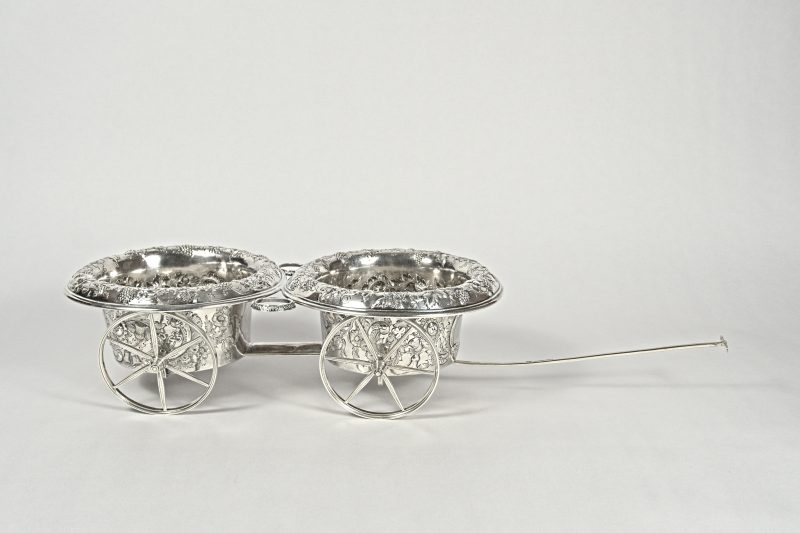 Silver Wine Wagon, c. 1850
Discover the Object →
Silver Wine Wagon, c. 1850
Discover the Object →
-
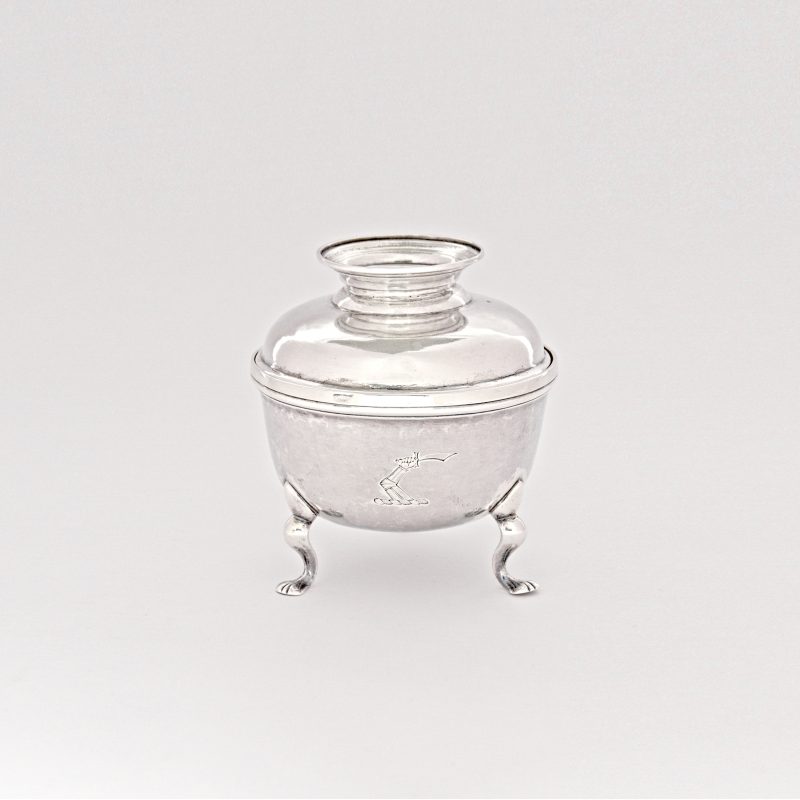 Silver Sugar Bowl, c. 1765
Discover the Object →
Silver Sugar Bowl, c. 1765
Discover the Object →
Reviews
There are no reviews yet.