
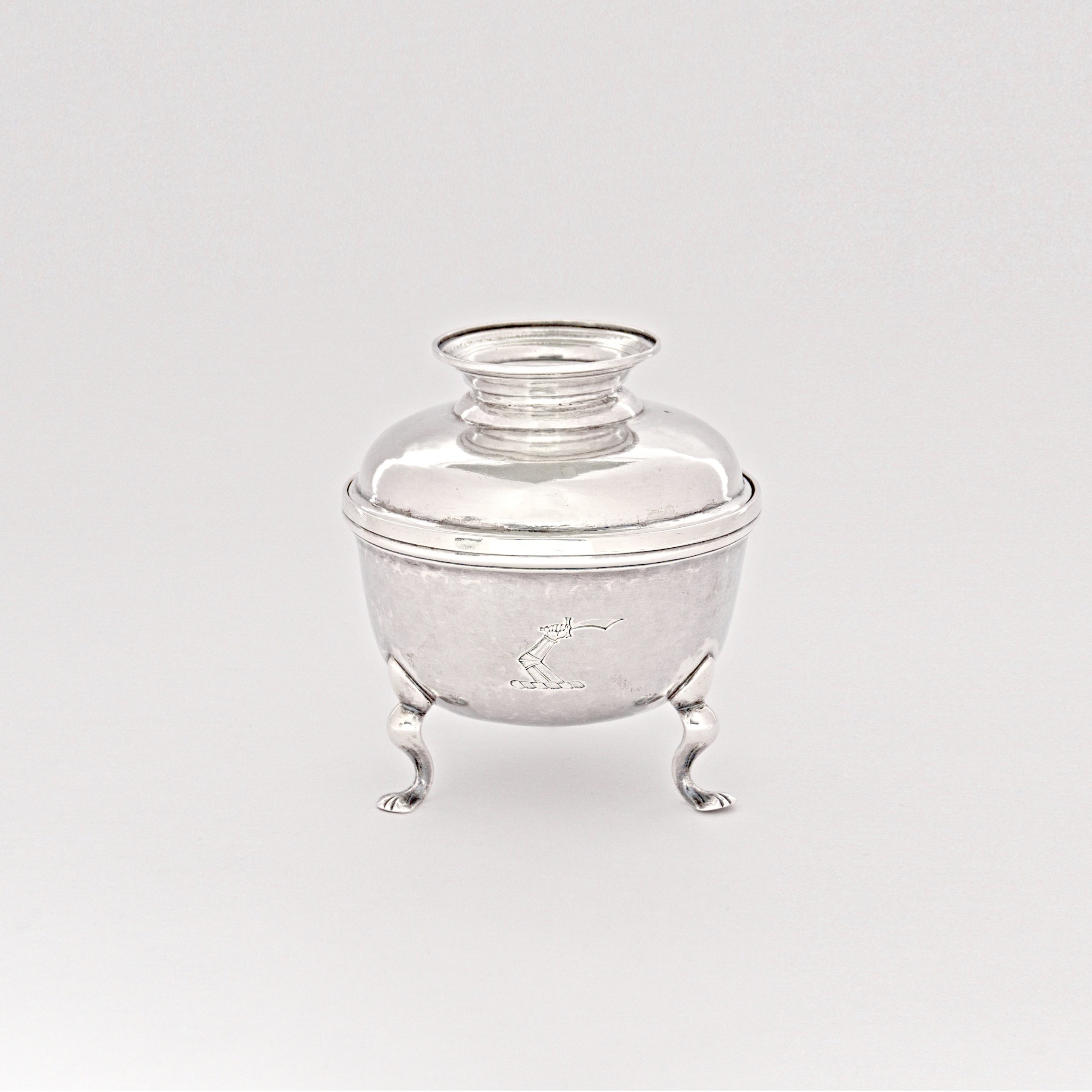
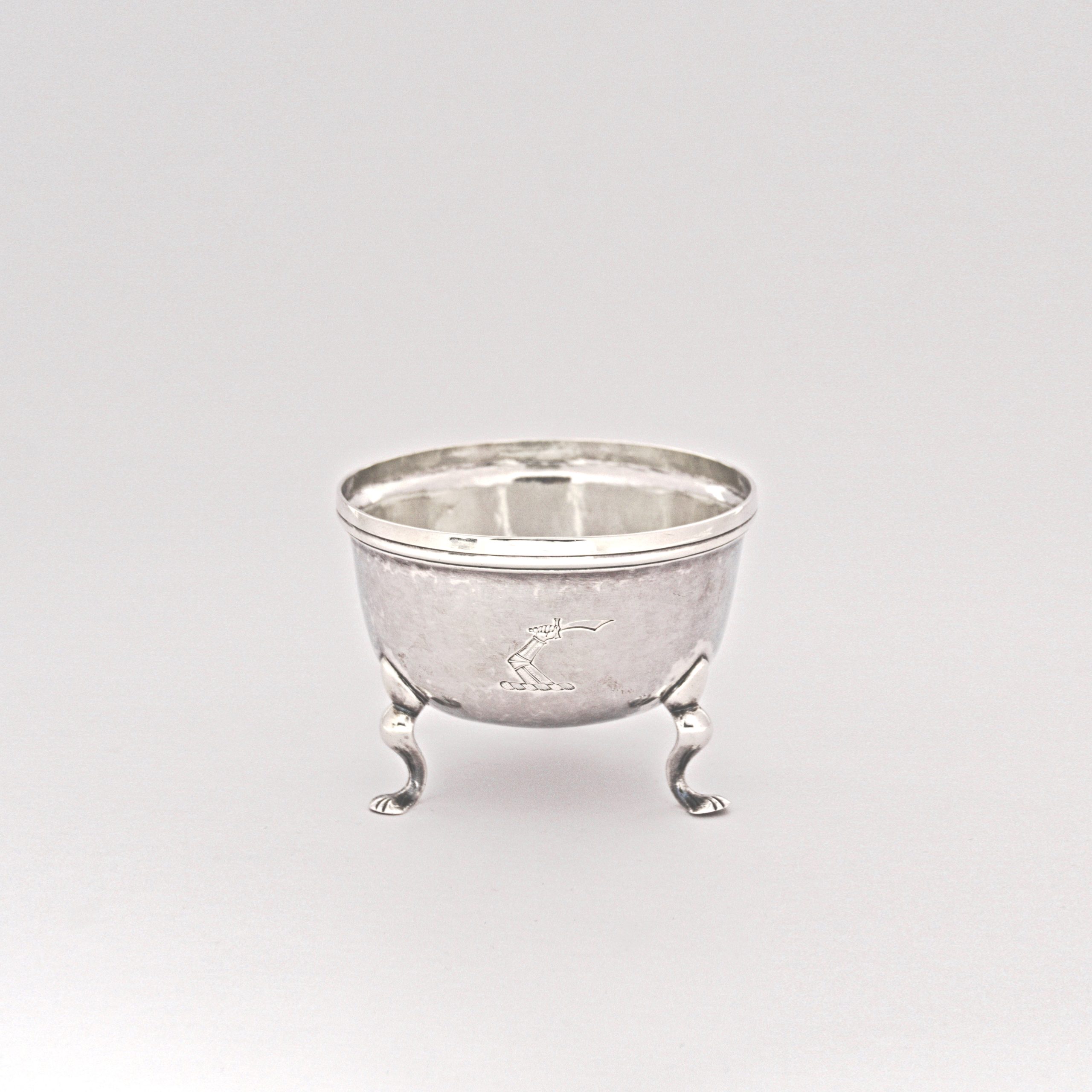
Silver Sugar Bowl, c. 1765
Charlestown, MA, by Josiah Austin
Height: 4.5 in.
In the mid-18th century, sugar was a luxury, and the vessels designed to hold it were centerpieces of the colonial tea table. While most sugar boxes and bowls from this period favored a traditional pedestal base or a "double-bellied" silhouette, this example breaks from convention.
Its tripod-footed design borrows a structural language more commonly seen in cream pots and salt cellars of the era, resulting in a hybrid form that is as stylistically daring as it is rare. Though the cover is a skillful modern reproduction, the bowl itself remains a primary document of pre-Revolutionary Massachusetts craftsmanship.
Sugar bowls in colonial American silver are quite rare, and rarer still is this form set on three feet. Most surviving examples from the mid-18th century follow the "inverted pear" or "round" shapes typical of the Rococo influence; a bowl of these proportions supported by three cast cabriole legs represents a highly individualistic choice by the silversmith.
Josiah Austin (1718–1780) of Charlestown was a prolific and respected maker whose career spanned the transition from the Queen Anne style to the more ornate Rococo.
The pedigree of this piece is well-documented in the annals of American silver scholarship, beginning with the engraved crest for the Bradstreet family. It was featured in Francis Hill Bigelow’s 1917 work Historic Silver of the Colonies and Its Makers, though interestingly, it was illustrated there with a different replacement cover, one done in high Victorian style and deeply incongruous with the profile of the piece. More recently, the bowl was included in Patricia Kane’s definitive Colonial Massachusetts Silversmiths and Jewelers (1998).
Provenance:
Norman W. Cabot
Jonathan Trace, January 2004
Literature:
Francis Hill Bigelow, Historic Silver of the Colonies and its Makers, 1917, p. 402-03 (illus. with different cover)
Patricia Kane, Colonial Massachusetts Silversmiths and Jewelers, 1998, p. 157
In the mid-18th century, sugar was a luxury, and the vessels designed to hold it were centerpieces of the colonial tea table. While most sugar boxes and bowls from this period favored a traditional pedestal base or a “double-bellied” silhouette, this example breaks from convention.
Its tripod-footed design borrows a structural language more commonly seen in cream pots and salt cellars of the era, resulting in a hybrid form that is as stylistically daring as it is rare. Though the cover is a skillful modern reproduction, the bowl itself remains a primary document of pre-Revolutionary Massachusetts craftsmanship.
Sugar bowls in colonial American silver are quite rare, and rarer still is this form set on three feet. Most surviving examples from the mid-18th century follow the “inverted pear” or “round” shapes typical of the Rococo influence; a bowl of these proportions supported by three cast cabriole legs represents a highly individualistic choice by the silversmith.
Josiah Austin (1718–1780) of Charlestown was a prolific and respected maker whose career spanned the transition from the Queen Anne style to the more ornate Rococo.
The pedigree of this piece is well-documented in the annals of American silver scholarship, beginning with the engraved crest for the Bradstreet family. It was featured in Francis Hill Bigelow’s 1917 work Historic Silver of the Colonies and Its Makers, though interestingly, it was illustrated there with a different replacement cover, one done in high Victorian style and deeply incongruous with the profile of the piece. More recently, the bowl was included in Patricia Kane’s definitive Colonial Massachusetts Silversmiths and Jewelers (1998).
Provenance:
Norman W. Cabot
Jonathan Trace, January 2004
Literature:
Francis Hill Bigelow, Historic Silver of the Colonies and its Makers, 1917, p. 402-03 (illus. with different cover)
Patricia Kane, Colonial Massachusetts Silversmiths and Jewelers, 1998, p. 157
-
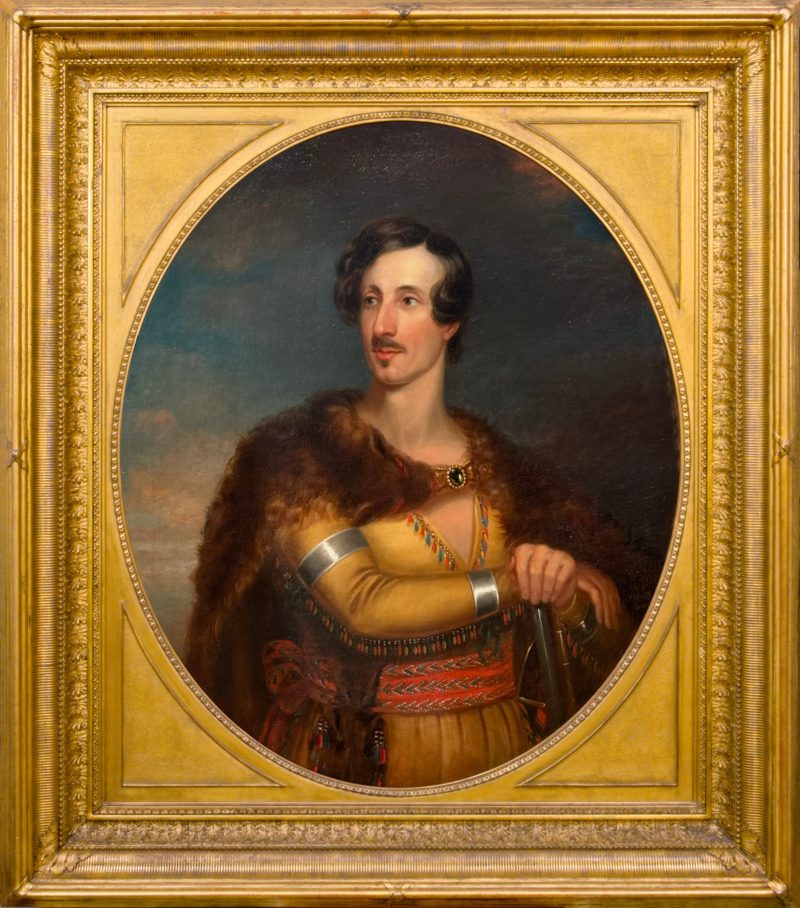 Portrait of Edward Seguin, 1840
Discover the Object →
Portrait of Edward Seguin, 1840
Discover the Object →
-
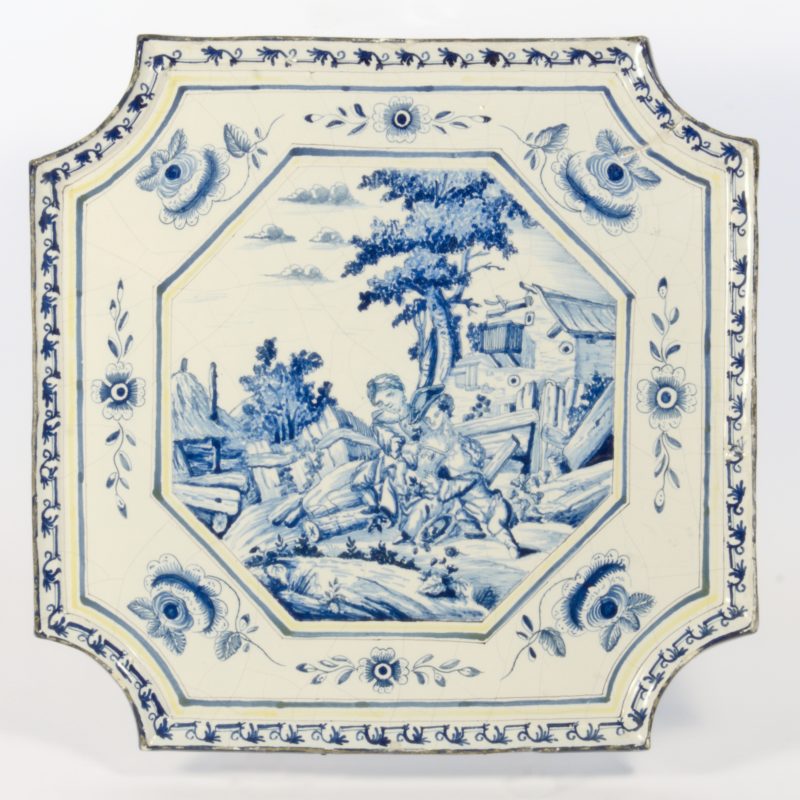 Delftware Plaque, c. 1885
Discover the Object →
Delftware Plaque, c. 1885
Discover the Object →
-
 Pair of Steel Tapersticks, c. 1780
Discover the Object →
Pair of Steel Tapersticks, c. 1780
Discover the Object →
Reviews
There are no reviews yet.